For the duration of Term 1, we will focus on the general Montessori principles that are relevant across all ages/stages of Dr Montessori’s educational method. At MIC, we have created an image that represents six general principles in the image of a human eye: the Montessori Lens.
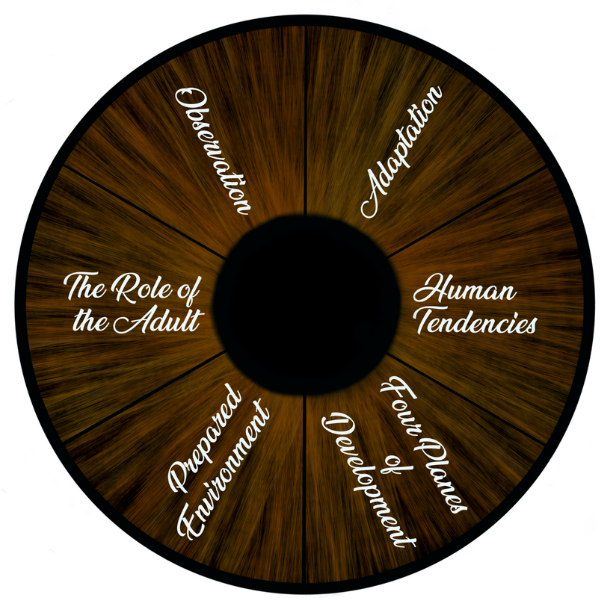
These six general principles serve as the foundation for MIC staff preparation and planning and are always considered in our decision-making processes.
They are:
- Adaptation
- Human Tendencies
- Four Planes of Development
- Prepared Environment
- The Role of the Adult
- Observation
The first general principle we will look at, which is highly relevant for new (and all) students/families and students transitioning into a new cycle or couplet is Adaptation.
All living species in the world adapt, and this is fundamental to who we are as human beings. However, unlike animals, which are bound by instinct and depend on evolution over time (generation to generation) to adapt, human beings continuously adapt and change to their environment. This premise is at the core of Montessori philosophy.
Human beings are the most successful adapters of all species, and this is due to key attributes:
- innate human tendencies that lead us to interact with the environment in a way that leads us to learn and adapt in order to survive;
- intelligence and specifically the ability to extract and abstract in order to be problem solvers;
- use of our hands as an extension of our intelligence to receive information and manipulate the environment, modify consciously, solve problems and meet needs;
- having a long childhood that gives us stages of development to allow for the complexity of human capacities to be developed over time; and
- the fact that we are social creatures who work collaboratively to meet the needs of the group.
Humans are designed for adaptation, and that is what education should be about – supporting the internal drive to learn and adapt through knowledge of the above attributes.
Montessori had a wide view on how humans engage on our planet – cosmic interdependence, through a system of interrelated agents in the cosmos, a web of interrelationships, cosmos is well ordered with sense of harmony, in general, a complex web of entities living and non-living that are adapting to the circumstances of the environment on an ongoing basis.
The first two weeks of learning at MIC have not just happened; MIC staff have been carefully preparing developmentally appropriate environments that meet the needs and characteristics of children and adolescents and their human tendencies. We will unpack more about the human tendencies in a future Montessori Moment.
Dr Montessori’s big picture view:
“The first thing to be realised is that adaptation is a relation of mutual exchange between every living being and its environment… each animal behaves in a particular way, not only for his own good, but because he works also for the environment. He is an agent who works for the harmonious correlation of all things.”
The Meaning of Adaptation, Citizen of the World, 1-12
Kind regards
Chris
Chris Peach – Principal
 How to apply
 Make an enquiry